TTRPGs of 2025
Tuesday, December 30, 2025 ・ Rpg
For me, 2025 has been all about tabletop RPGs. They’re such a crucible of the creative arts. A popular thought is that TTRPGs are experiencing a golden age, and the briefest survey of the flowering of games that are around right now — systems, settings, scenarios, adventures, and so much more — is good evidence that’s true.
So, it’s a good time to be devoting more attention to them. I’ve been playing weekly sessions for several years, but in 2025 I began playing in a second group: double time to experience new games and new table cultures. I also ran a campaign as GM, and in the summer I released a couple of my own small games, Board of Mammon and Fortune Dark. And I’ve been working on another bigger project, too.
To mark the close of the year, here are the TTRPGs that have been most important to me in 2025.
The Between
Awful heroes hunt monsters in a histronic vision of Victorian London.
The setting and melodramatic tone of this very theatrical investigation game weren’t a big draw for me, but The Between’s core design is wonderful and it led to an extraordinarily rich campaign of horrible ghosts, frantic investigation, and interaction between us players.
For me, a lot of it was down to the way its playbooks define character development and inter-character bonds, while also encouraging risky and dramatic play. For example, as I used my Factotum character Waldon’s supply of Masks of the Past to improve bad rolls, the prompts on his playbook helped me tell a particular and horrible backstory about his experiences as a soldier in the imperial British army, such as:
Narrate a flashback to your young adulthood, before you were a servant, that shows your most significant professional triumph.
Getting the spotlight to give these directed vignette flashbacks about my character was thrilling. I prepared ahead of sessions a little, sketching Waldon out, so I looked ahead but totally overlooked the potential of one of the Factotum’s special Masks, The Moss-Covered Gate, which reads, “Unmark the first two boxes on the Mask of the Past.”
It’d seemed so innocuous, but deep into the campaign, as my Masks had begun to run out, I saw it anew: it allowed me to recharge two Masks at the cost (?) of creating a new backstory. I decided that Waldon’s original tale of a bucolic childhood and (profoundly questionable) valour in service of the Queen was a huge lie.
Playing out that change meant so much for his character at this late point in the campaign and was a lot of fun to give the rest of the group the twist that he was never a hero, and it reconfigured his relationship with his employer, Jim’s Undeniable. I’ve never played a TTRPG in which character development is so intrinsic and carefully directed.
Here’s more from Jim, as part of his write-up with Kieron here:
…my character, the shockingly beautiful Alina Gray, was The Undeniable, and as such the [Mask] prompts can only end up revealing her to be an awful person whose powers are woven with humiliation, exploitation, and destruction of others, due to her (literally) towering narcissism. As we responded to the prompts and filled out the story of our characters, the true nature of these monstrous people was revealed.
Blades in the Dark
Vie for power as a gang of thieves on the streets of an eternally benighted fantasy-Victoriana city.
We’re back, baby. My group and I have been playing Blades for years now, and we picked it up again with some of the same characters as our last campaign and also with a new group member, Will. It was nice to be back in the saddle, though it’s actually a new saddle: we’re playing the recently released Deep Cuts supplement, which tweaks a bunch of core rules and adds a chunk of fresh content.
Why do I like Blades in the Dark? It’s fast, dynamic and all about improvisational play, great for encouraging big risks (a lot of our heists end up with our characters jumping out of windows to escape terrible situations we’ve caused) and its setting, inspired by Dishonored, is grounded yet judiciously fantastic. My character, for example, died between the end of our old campaign and the start of our new one, and now he’s a very angry ghost.
Deep Cuts’ changes seem focused on encouraging even more risk-taking, which I like. Actions generally automatically succeed, with rolls deciding the consequences, and if you invoke injuries and afflictions your character has suffered in an action, you’ll earn XP. This means there are great incentives to making big, dangerous, and difficult swings. Is it as good as Blades’ classic position-and-effect roll system? I think it’s an alternative rather than a pure improvement, and mostly attractive to me for its freshness, and that’s been enough.
Mythic Bastionland
A knightly hex-crawl through a land beset by mythic threats and quests.
Good god I love this game. First hit: Alec Sorensen’s gorgeous artwork in the book, a melding of the pre-Raphaelites, medieval illuminated texts, and modern graphic arts. Sumptuous and defining, yet giving so much space for your own imagination. And there’s so much of it. Man!
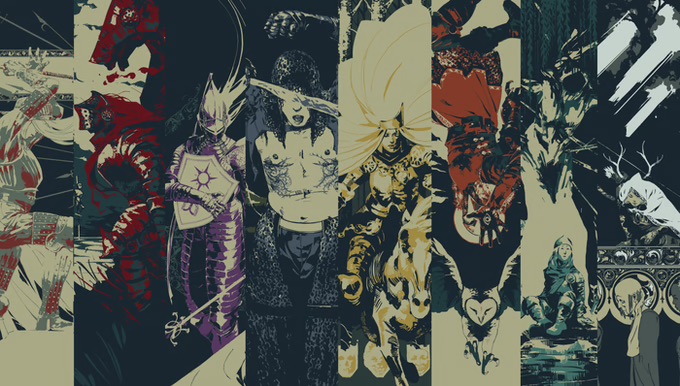
Second: the knights. 72 of them, each with a few bare details that give great latitude to flesh them out: a two-line verse, their equipment and horse, an ability, the passion that drives them, and the bizarre seer who knighted them. The Glass Knight, barer of a pike and six-inch needle that only they can remove, able to see through anything they can touch, and driven by looking into places they shouldn’t:
Revealer of all secrets, in stark, judgemental light
In cold and sharpened heart lies no deceitful spite
Third: the spare rules writing. Stiff and formal, a little like the knights you play, it sets out simple procedures in short paragraphs which seem almost impossible to turn into a game of realm-crossing scope. But as you start to play they begin to interlock with each other.
Fourth: the vows and how they guide your knight’s decisions in an open and living world: “Seek the Myths; Honour the Seers; Protect the Realm”. They set out priorities, set in relation to the scant details of the knight you’re playing, that are clear.
Fifth: the way myths play out, strange and meaningful, regardless of whether your knight gets involved or not. You come across omens, strange events you may witness or merely hear about, and they progress through a set which tells a story and affects the land. Do you intervene? Resolve? The vows will help you decide.
Sixth: free exploration of lands which always yield interest. On every page of the book lie a series of “spark tables”, randomised details that the GM can use to add detail to a location. I found Mythic Bastionland extraordinarily engrossing, its world woven from a book that’s effectively made from roll tables: 72 knights; 72 myths; 72 hazards, monuments, curses, ruins and so much more. Through exploration they are spun into a world in which I’m looking forward to playing more in 2026.
Night’s Black Agents: The Dracula Dossier
Secret agents investigate an international conspiracy run by Dracula himself.
I GMed a campaign of the Dracula Dossier this year, which sets the agent loose in a cross-European sandbox of characters, locations and things defined by Dracula and his doings. It’s fantastic and (ah, this is true for so many GMs, right?) I wish I’d done it true justice.
Night’s Black Agents’ vanilla Gumshoe system didn’t fully work for my group, as I’ve written, but I don’t think it’s an indictment of the system itself, more about our taste and my ability to fully make it work.
In fact, I keep thinking about ways I could have run the campaign better. I could have helped set player expectations for what was to come and to have inspired them to fully invest in the sandbox as a place of free choice in what to investigate. I should’ve piled on more pressure — dialled up the Heat from the authorities and the mental load from facing supernatural horrors. I could have laid out the shape of the conspiracy they were facing so they had a better sense of where they were and where it was going.
Ah regrets, regrets. But I also need to hold myself up a little and remember that we had some good sessions where things flowed nicely and I seemed to deal due surprise and tension.
Honourable mentions
- Gold Teeth: We spent a chunk of the year play-testing Jim and Marsh’s game of horrible pirates, which they successfully Kickstarted in 2024. It’s a special one.
- Deathmatch Island: We only just started this Paragon-based game of Battle Royale and Squid Games, but session one was a lot of fun.
- Mothership: We played a few one-off sessions in 2025, and we’ve still yet to experience Mothership truly working for us, but we haven’t given up on it yet.
- The Doomed: An honorary mention since The Doomed is a tactical skirmish tabletop game, but it’s by Mythic Bastionland designer Chris McDowall and it features light RPG elements, sort of, and it’s great.